



To understand the difference between gasoline engines and diesel engines, we first need to understand the difference between gasoline and diesel. Petroleum is mainly refined by fractional distillation, which means crude oil is first heated to produce vapors of different substances, and then the vapors are cooled to refine different products, such as gasoline, diesel, kerosene, lubricating oil, asphalt, and so on.
Gasoline has a small molecular weight, so its boiling point is only 20-220°C, but its ignition point is above 400°C. Diesel has a larger molecular weight and longer carbon chains, so its boiling point is higher, while its ignition point is only 220°C.
This difference in fuel characteristics also leads to major differences between gasoline engines and diesel engines.
I.Different ignition methods
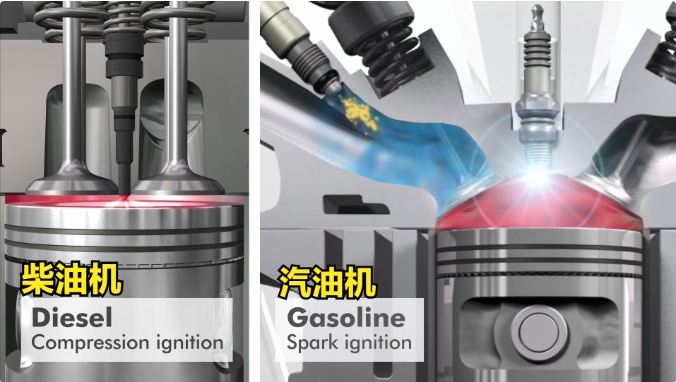
Because gasoline has a high ignition point, after the engine piston compresses the mixture, it must be ignited by a spark plug
Diesel engines, however, do not require spark plugs. They rely on the temperature rise after air compression to directly cause diesel self-ignition
This compression-ignition effect also gives diesel engines many advantages, such as not requiring an ignition system and therefore having a lower failure rate; the compression-ignition method also allows a very high compression ratio. A conventional gasoline engine is already considered high at 13:1, but a diesel engine can easily reach 17:1
By using longer connecting rods to increase piston stroke, engine torque is greatly improved, and with the same displacement, diesel engines also deliver better fuel economy
II.Different engine speeds
Gasoline engines can prepare a premixed charge, meaning gasoline and air are mixed first and then injected into the cylinder, or direct injection can be used to atomize gasoline through a high-pressure injector while mixing and compressing inside the cylinder
At top dead center of the piston, the mixture is ignited by the spark plug.In short, gasoline and air are mixed first and then burned
However, diesel has high viscosity and cannot mix effectively with air, so a diesel engine first takes in air,then compresses and heats the air, and only when the piston is close to top dead center is diesel injected, using the hot air to ignite the diesel
The entire combustion process is also divided into the ignition delay period, rapid combustion period, slow combustion period, and afterburning period.One obvious disadvantage of this method is that it requires a longer combustion time, and the longer piston stroke mentioned earlier serves this purpose as well
Therefore, diesel engine speed cannot be made too high.If the speed is too high, the diesel will not burn completely, resulting in heavy black smoke, and torque will also decline
For example, the largest engine in the world, the diesel engine installed on a ship, has a rated speed of only 102r/min
The engine speeds of many diesel versions of automobiles are also far lower than those of gasoline versions


Add: Zhaiqiao Industrial Cluster,Qianhuang Town,Wujin District,Changzhou City,Jiangsu Province,China
Tel/Fax: +86-0519-85188296
Phone: +86-13801500234 / +86-13961492147
Postcode: 213172
Email: info@kyhon.com